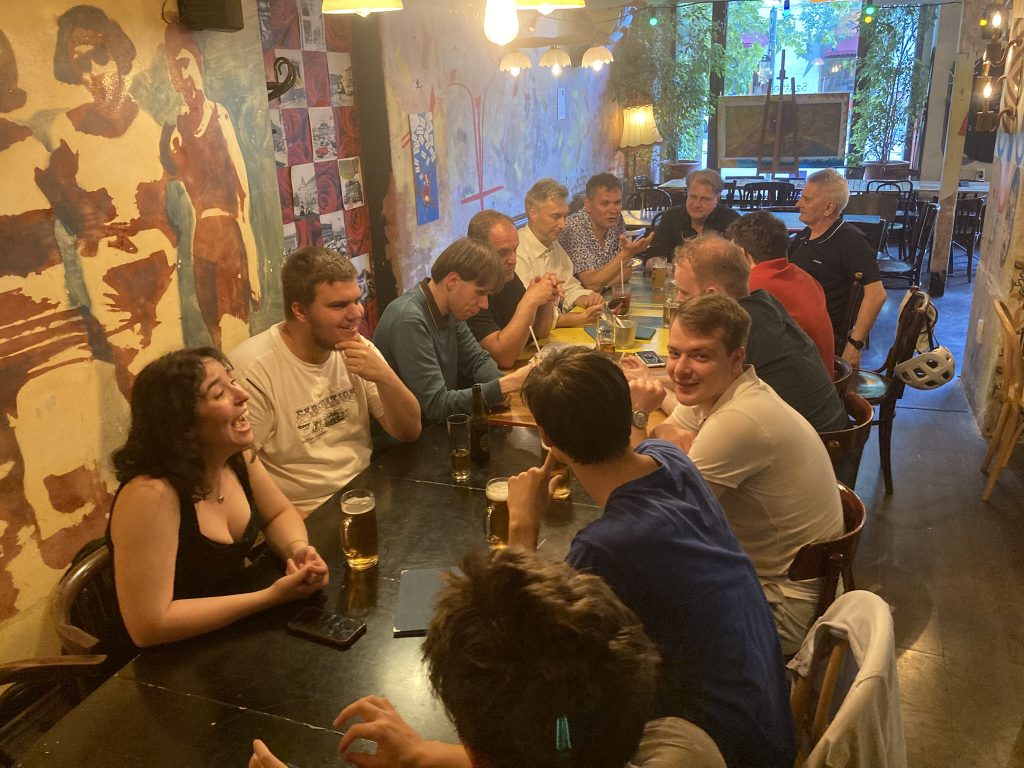
In June 2025, Eötvös Loránd University hosted two distinguished international researchers: Professor Jaroslav Fabian from the University of Regensburg and Professor Branislav K. Nikolić from the University of Delaware. This strategic visit facilitated high-level scientific exchange in theoretical spintronics and quantum physics while establishing concrete collaborative frameworks for code development and numerical simulation sharing. The visit exemplifies the type of international partnership that strengthens European research capabilities and aligns with EU objectives for scientific excellence and technological advancement.
Research Presentations
Professor Jaroslav Fabian: Spin Proximity Effects in 2D van der Waals Heterostructures

Institution: University of Regensburg
Professor Fabian delivered an insightful presentation on spin proximity effects in two-dimensional van der Waals heterostructures, focusing on insights derived from density functional theory (DFT) investigations. His talk emphasized two fundamental spin interactions critical for spintronics applications in 2D materials: spin-orbit coupling and exchange coupling. The presentation demonstrated how both interactions can be efficiently tailored through van der Waals engineering techniques, including straining, twisting, gating, and strategic stacking arrangements. Professor Fabian presented specific case studies of spin-orbit and magnetic heterostructures, elucidating the crucial roles that strain and twist play in manipulating magnetic and electronic properties. This work represents cutting-edge research in engineering magnetic properties of low-dimensional systems and provides valuable theoretical frameworks for designing next-generation spintronic devices.
Professor Branislav K. Nikolić: Schwinger-Keldysh Field Theory for Driven-Dissipative Spin Systems
Institution: University of Delaware

Professor Nikolić presented a comprehensive theoretical framework addressing one of quantum physics’ most challenging problems: driven-dissipative many-body systems with applications to spintronics, magnonics, and quantum computing technologies. His presentation explained the conditions under which quantum spins interacting with dissipative environments can transition toward classical dynamics governed by the Landau-Lifshitz-Gilbert (LLG) equation. The work demonstrated how an extended LLG equation incorporating non-Markovian and spatially nonlocal damping of quantum origin can be rigorously derived from Schwinger-Keldysh quantum field theory. The research successfully explained recent experimental observations of 100-fold increases in magnon damping in yttrium iron garnet due to metallic overlayers, providing crucial insights for magnonics applications. Additionally, the theoretical framework addresses fully quantum spin dynamics by combining advanced field theory techniques originally developed for elementary particle physics, offering numerical approaches that can track longer timescales and higher spatial dimensions where traditional tensor network methods encounter limitations.
Collaborative Agreements and Technical Exchange
The visit resulted in concrete agreements for technical collaboration and code development that will significantly enhance our computational capabilities. The University of Regensburg has committed to providing Wannier90 outputs and Quantum ESPRESSO outputs to support the testing and improvement of our GROGU code development project. This collaboration will enable rigorous benchmarking and validation of our computational methods against established international standards.
Similarly, the University of Delaware will contribute OpenMX input and output files for the same purpose, providing additional validation datasets and computational benchmarks. These technical exchanges represent substantial value-added contributions that will accelerate our code development efforts and ensure our computational tools meet international standards for accuracy and reliability.