
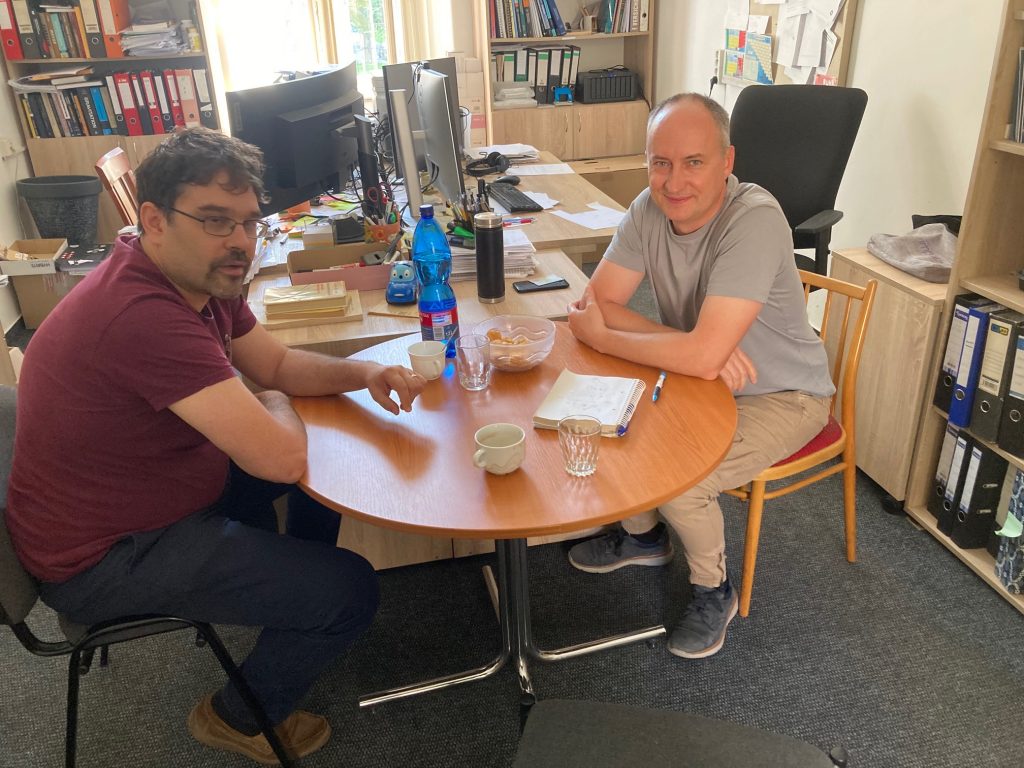
Representatives from the ELTE node, Zoltán Tajkov and László Oroszlány, conducted a strategic visit to Pavol Jozef Šafárik University in Kosice to engage with leading researchers Martin Gmitra, Timon Mosko, and Maedeh Rassekh. This collaboration-focused visit aimed to expand the user base of our GROGU computational code, establish testing partnerships, and develop future joint research initiatives. The visit represents a significant step in building regional research networks and advancing computational capabilities within the Central European research community, aligning with broader European objectives for scientific collaboration and technological advancement.
Collaboration Objectives and Outcomes
GROGU Code Promotion and Community Building
The primary objective of the visit was to promote the adoption of GROGU within the Heisenberg model research community for obtaining Heisenberg parameters in computational studies. The ELTE team presented the capabilities and advantages of the GROGU code, emphasizing its potential to standardize and streamline Heisenberg parameter extraction across different research groups. This initiative represents a crucial step in building a broader user community that can provide feedback, testing, and collaborative development opportunities.
The discussions focused on expanding the code’s features to incorporate enhanced Wannier90 and OpenMX capabilities, which would significantly broaden its applicability and appeal to diverse research groups working with different computational frameworks. The Kosice team expressed strong interest in participating in this development effort, particularly given their expertise in complementary computational approaches.
Technical Collaboration and Testing Partnerships
Concrete agreements were established for technical collaboration and code validation. Timon Mosko committed to providing complete Quantum ESPRESSO calculations for NbSi₂N₄ or TaSi₂N₄ systems, including both input and output files as well as corresponding Wannier90 results. This comprehensive dataset will enable thorough testing of the GROGU workflow and validation of its integration with established computational packages.
Maedeh Rassekh agreed to share state-of-the-art OpenMX calculations for CrI₃ systems, including both input and output files. This contribution will be particularly valuable for testing and developing GROGU’s OpenMX integration capabilities, expanding the code’s compatibility with different DFT implementation approaches.
Future Research Initiatives
The collaboration discussions identified opportunities for joint computational research articles that would showcase GROGU’s capabilities across different materials systems and DFT approaches. Building on theoretical frameworks suggested by previous collaborations, the team plans to develop comprehensive studies that demonstrate the versatility and accuracy of the GROGU approach across diverse magnetic systems.
This initiative aligns with the broader goal of establishing standardized computational protocols for Heisenberg parameter extraction while contributing to the scientific literature on computational magnetism and spintronics.
Educational and Training Components
TRILMAX Theory Summer School
The visit included promotion of the TRILMAX Theory Summer School in Oviedo, with particular emphasis on encouraging participation from the Kosice research group. Timon Mosko was specifically invited to register for the summer school, which represents an important opportunity for knowledge transfer and community building within the broader European research network.
The summer school initiative demonstrates the consortium’s commitment to training the next generation of researchers in advanced computational methods and theoretical approaches to magnetism and spintronics. The international participation from partner institutions like Jozef Safarik University enhances the educational value and builds lasting collaborative relationships.
Strategic Impact and Regional Collaboration
The visit successfully established a foundation for ongoing collaboration between the ELTE node and Pavol Jozef Šafárik University, creating a model for regional research cooperation in Central Europe. The technical exchanges and joint development initiatives will strengthen computational capabilities at both institutions while contributing to the broader European research ecosystem.
The collaboration demonstrates how specialized computational tools can serve as focal points for building research communities and facilitating knowledge transfer across institutional boundaries. The GROGU code development project has evolved into a platform for international collaboration that extends beyond its original technical objectives.
Future Developments and Commitments
The visit established clear timelines and deliverables for the collaborative relationship. The technical contributions from Kosice will directly support GROGU development and validation efforts, while the joint research initiatives will provide opportunities for high-impact publications and future funding applications.
The ongoing communication channels established during the visit ensure sustained collaboration and regular progress updates on both technical development and research initiatives. The partnership positions both institutions to compete effectively for future European research funding opportunities in computational materials science and quantum technologies.
Conclusion
The ELTE node visit to Pavol Jozef Šafárik University in Kosice represents a successful example of strategic collaboration development within the Central European research community. The technical partnerships established will directly benefit computational tool development while the research collaborations promise to advance the field of computational magnetism.
The visit demonstrates the effectiveness of direct engagement in building research partnerships and highlights the potential for regional collaboration networks to contribute meaningfully to European scientific excellence. The ongoing relationships established will provide lasting benefits for both computational capabilities and research output across the participating institutions.