
The HZB node of the TRILMAX EU consortium made a significant impact at the DPG Spring Meeting of the Condensed Matter Section in Regensburg, Germany, held from March 16-21, 2025. PhD student Yara Mahboub represented the team as the first author of a prominent poster presentation, showcasing cutting-edge research on magnetic spin textures in two-dimensional van der Waals magnets. The presentation demonstrated the consortium’s expertise in experimental magnetism and materials characterization, contributing to the broader European research excellence in quantum materials and spintronics.
Research Presentation
Magnetic Spin Textures in Room Temperature 2D van der Waals Magnet Fe₃GaTe₂
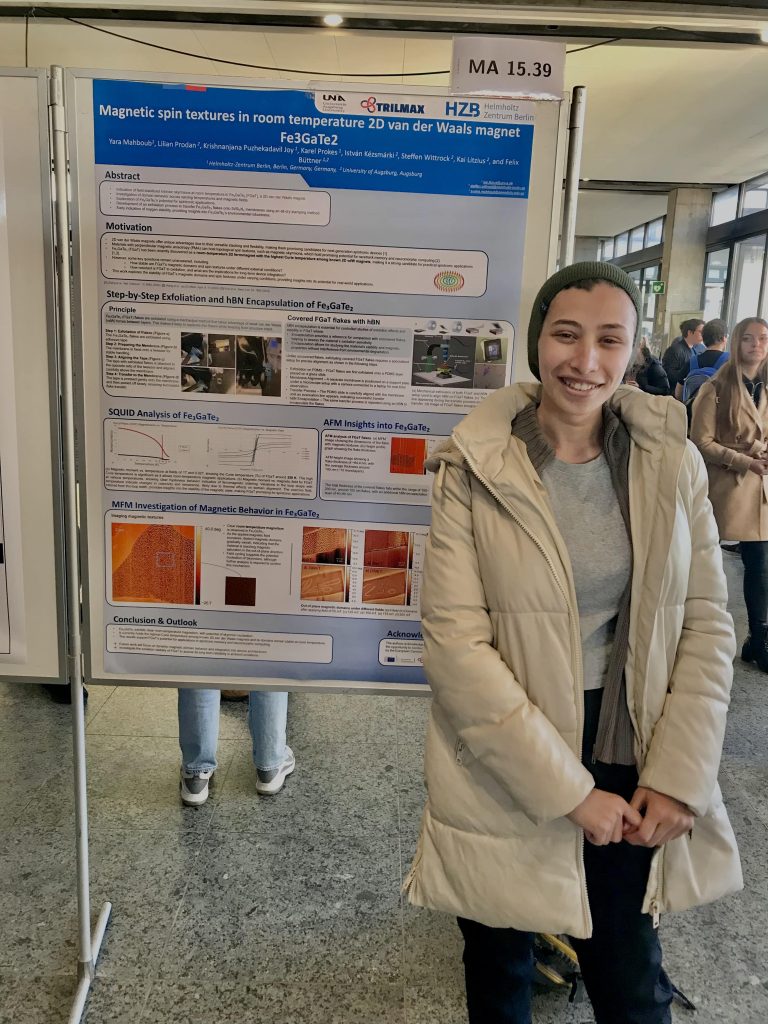
First Author: Yara Mahboub
Conference Section: Condensed Matter Physics
The poster presentation focused on the investigation of magnetic spin textures in Fe₃GaTe₂, a promising two-dimensional van der Waals magnet that exhibits magnetic ordering at room temperature. This research addresses one of the key challenges in 2D magnetism: achieving stable magnetic behavior under ambient conditions, which is crucial for practical spintronic applications.
The work presented a comprehensive experimental approach combining multiple characterization techniques to understand the magnetic behavior of Fe₃GaTe₂. The research demonstrated step-by-step exfoliation and hexagonal boron nitride (hBN) encapsulation processes for Fe₃GaTe₂, showcasing advanced sample preparation techniques essential for studying air-sensitive 2D magnetic materials.
The experimental investigation included SQUID (Superconducting Quantum Interference Device) analysis of Fe₃GaTe₂, providing detailed magnetic characterization data. The study also employed AFM (Atomic Force Microscopy) insights to understand the structural properties and their correlation with magnetic behavior. Additionally, MEM (Magnetic Exchange Microscopy) investigations revealed the magnetic domain structures and spin textures present in the Fe₃GaTe₂ samples.
The research findings contribute significantly to understanding room-temperature magnetism in van der Waals materials, addressing fundamental questions about spin texture formation and stability in reduced-dimensional magnetic systems. The work has important implications for the development of next-generation spintronic devices based on 2D magnetic materials.