
The TRILMAX ELTE node participated in the DPG Spring Meeting of the Condensed Matter Section (SKM), held at Dresden University of Technology from 8 to 13 March 2026. The conference provided an excellent opportunity to present recent theoretical and computational results connected to the TRILMAX research programme, ranging from quantum-information platforms to two-dimensional magnets, relativistic spin models, and spintronic materials.
On Monday, László Oroszlány presented the talk “Towards measurement based quantum computation with multipods” in the Quantum Information session “Implementations I”. The presentation introduced a Hubbard-star construction at half filling as a possible route toward realizing Affleck-Kennedy-Lieb-Tasaki (AKLT) physics in tunable quantum-dot arrays. Since AKLT ground states are known resources for measurement-based quantum computation, the work connects model-Hamiltonian engineering with possible quantum-computational phases in recently developed highly tunable artificial systems.
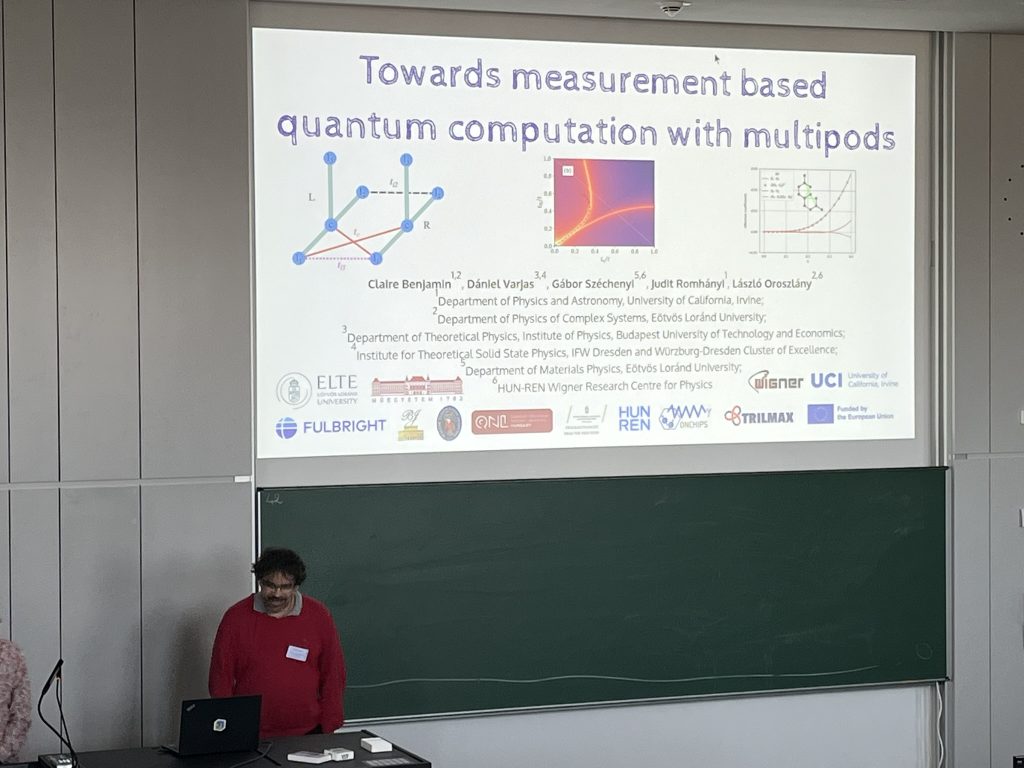
László Oroszlány presenting his talk “Towards measurement based quantum computation with multipods” at the DPG Spring Meeting 2026 in Dresden.
On Friday, three TRILMAX-related contributions were presented in the “Computational Magnetism II” session of the Magnetism Division. Zoltán Tajkov gave a talk entitled “Proximity-Induced Magnetic Phases in CrI₃ Monolayers Coupled to Transition-Metal Dichalcogenide Monolayer”. The work focused on the proximity-induced modification of magnetic phases in CrI₃/WTe₂ heterostructures, using SIESTA-based density-functional theory calculations and a relativistic extended Heisenberg spin-model framework. The presentation highlighted how a monolayer magnet can be modified by coupling it to a strong spin–orbit material, and how exchange and anisotropy tensors can be extracted using an LKAG-type torque formalism.
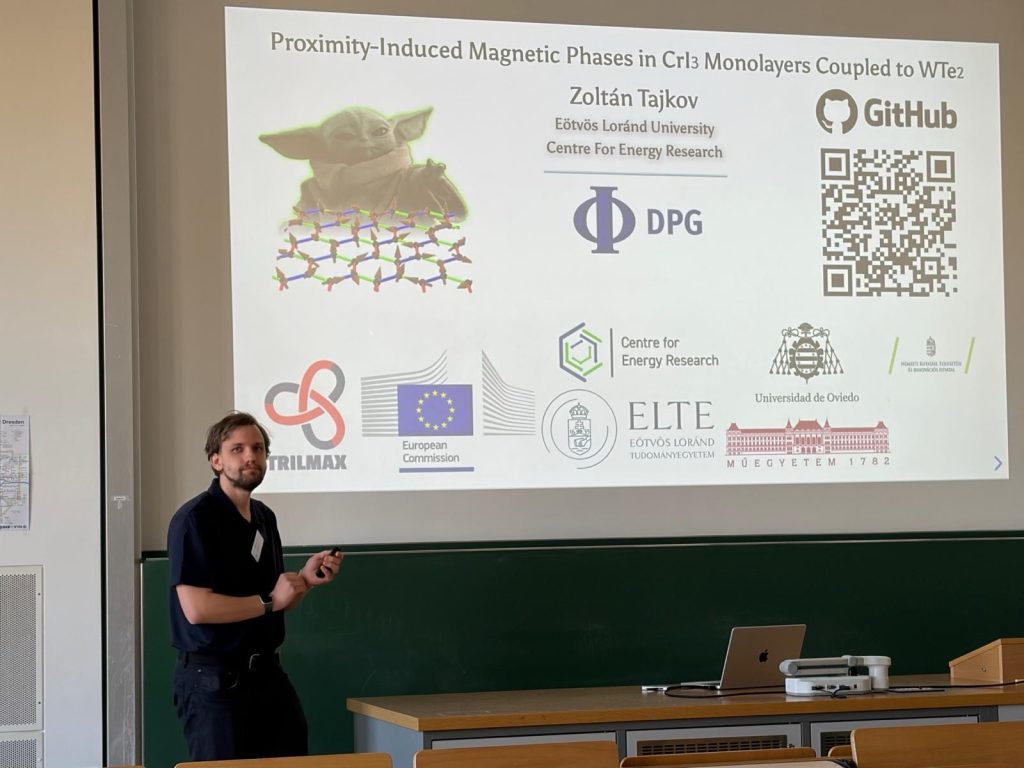
Zoltán Tajkov presenting proximity-induced magnetic phases in CrI₃/WTe₂ heterostructures.
Tamás Véber presented “First-principles calculation of current-induced spin-transfer and spin-orbit torques”. His talk addressed the theoretical modelling of current-induced torques in two-dimensional magnetic materials, with particular focus on spin-transfer torque and spin-orbit torque in the linear-response regime. The work aims to build a coherent and interoperable ab initio software workflow for such calculations, with a strong emphasis on open and reusable computational tools.
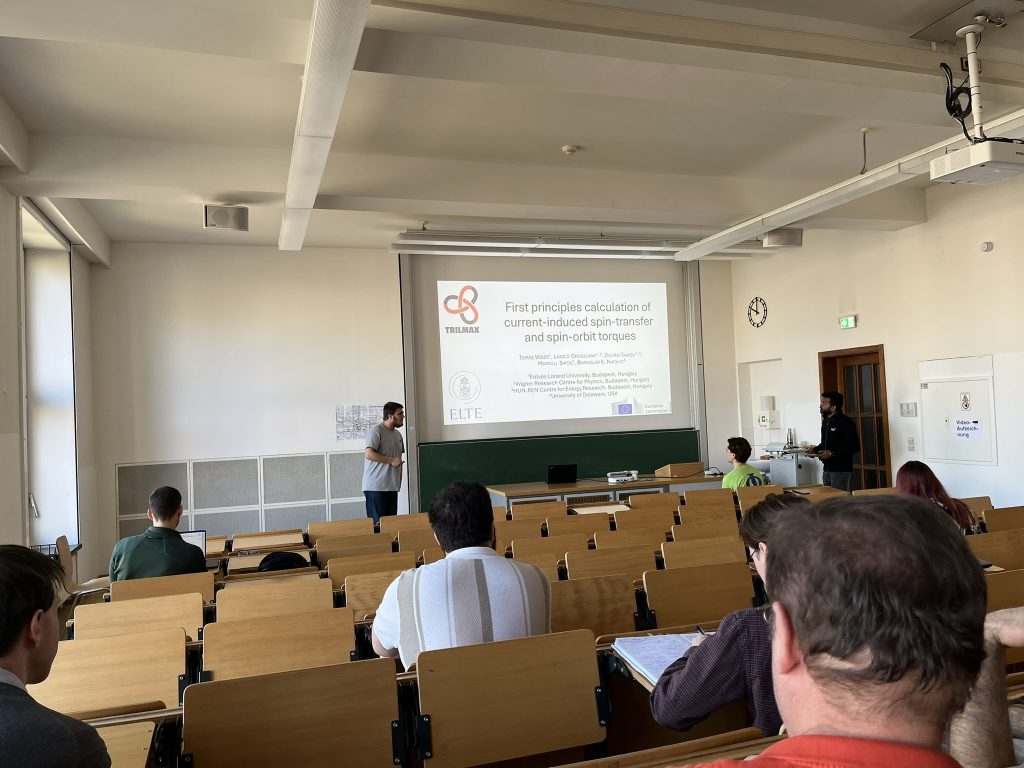
Tamás Véber presenting his work on first-principles calculations of current-induced spin-transfer and spin-orbit torques.
Anjali Jyothi Bhasu presented “Above-Room-Temperature Magnetism in the Fe₃GeTe₂ and Fe₃GaTe₂ monolayer”. Her contribution focused on the magnetic interactions and ordering temperatures of two-dimensional van der Waals ferromagnets. Using density-functional methods, LKAG torque formalism, spin-cluster expansion, relativistic disordered local moment theory, and large-scale Monte Carlo simulations, the work investigated how magnetic interactions and transition temperatures depend on the Hubbard U parameter in Fe₃GeTe₂ and Fe₃GaTe₂ monolayers.
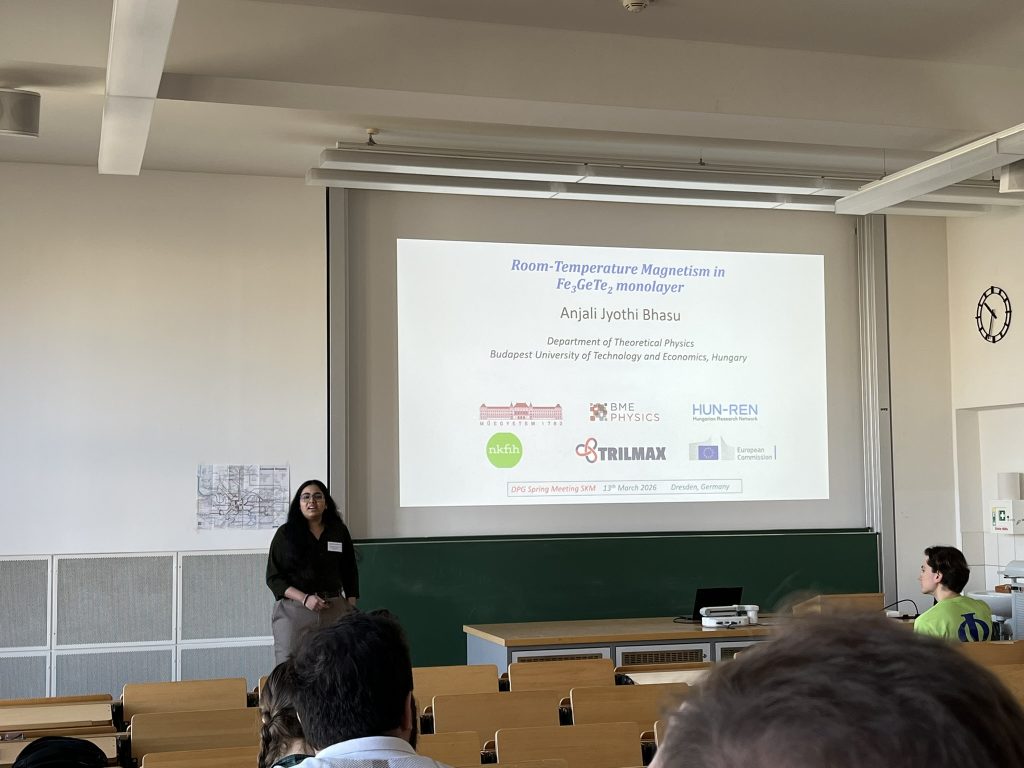
Anjali Jyothi Bhasu presenting her results on room-temperature magnetism in Fe₃GeTe₂ and Fe₃GaTe₂ monolayers.
The four presentations demonstrated the broad scientific scope of the TRILMAX network, covering quantum-information-inspired model systems, first-principles modelling of two-dimensional magnetic heterostructures, ab initio spin-torque calculations, and finite-temperature magnetism in van der Waals materials. The conference also strengthened the visibility of the TRILMAX project within the international condensed-matter and magnetism communities. TRILMAX and EU project visibility was ensured through the presentation slides, where the project logo and EU funding acknowledgement were displayed.