
From 6 to 10 April 2026, László Szunyogh and Anjali Jyothi Bhasu from the Budapest University of Technology and Economics (BME) visited Jaime Ferrer and the Oviedo node of the TRILMAX consortium. The visit strengthened the ongoing collaboration between the Budapest and Oviedo teams on the theoretical and computational modelling of magnetic van der Waals materials.
A central topic of the visit was the joint work on strain-induced magnetic phase transitions in monolayer Fe₃GeTe₂. This project combines first-principles electronic-structure calculations with atomistic spin-dynamics simulations to understand how lattice distortions can tune the magnetic interactions, ordering temperature, and magnetic ground state of a two-dimensional ferromagnet. The discussions focused on the connection between ab initio calculations, effective spin models, competing exchange interactions, magnetic anisotropy, and finite-temperature magnetic phases.
During the visit, Anjali Jyothi Bhasu also presented her recent results on two-dimensional magnetic materials. Her presentation provided a starting point for detailed scientific discussions with the Oviedo team, including Jaime Ferrer, Gabriel Martinez-Carracedo, Rosa Eulalia González Ferreras, and Balázs Nagyfalusi. The meeting created an ideal setting for comparing computational approaches, checking modelling assumptions, and refining the interpretation of the emerging results.
The visit was particularly valuable because it brought together complementary expertise within the TRILMAX network. The BME team contributed strong experience in relativistic magnetism, spin-orbit coupling, and DFT-to-spin-model methodology, while the Oviedo node added expertise in electronic-structure calculations, magnetic interactions, quantum transport, and computational modelling of low-dimensional systems. The direct whiteboard discussions and in-person exchange helped accelerate the joint work and contributed to a clearer understanding of the complex magnetic phase behaviour of Fe₃GeTe₂ monolayers.
This mobility activity is a good example of how TRILMAX supports collaboration across nodes. Beyond the scientific progress on a concrete joint manuscript, the visit also strengthened personal links between senior researchers, postdoctoral researchers, and PhD students. These exchanges are essential for building a durable European research network in the field of magnetic van der Waals materials, and they directly support the TRILMAX goal of developing shared theoretical and computational tools for future spintronic materials.
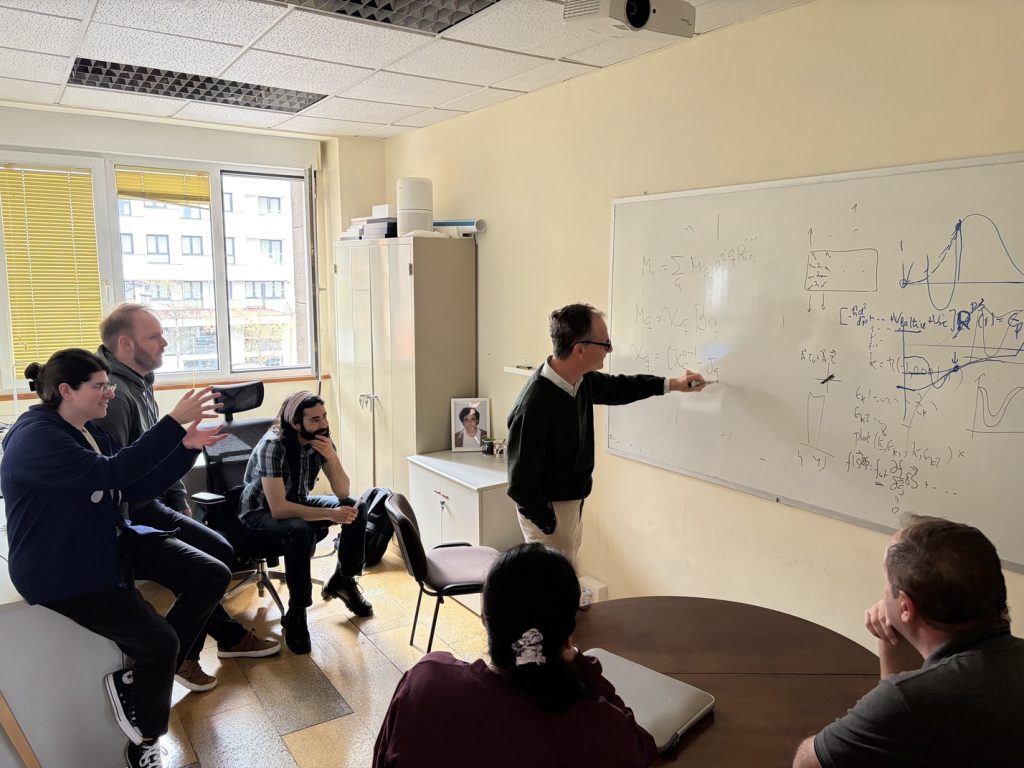
Scientific discussion during the BME–Oviedo node visit, focusing on first-principles modelling and spin-model approaches for two-dimensional magnetic materials.