
In May 2025, three researchers from our Budapest consortium node successfully participated in the prestigious “Let’s Give It a Spin!” conference held in Belgrade. This international gathering provided an excellent platform for presenting our cutting-edge research in magnetism and spintronics while fostering valuable scientific exchanges with the global research community. The participation demonstrates our consortium’s active engagement in disseminating research outcomes and building international collaborations in line with European Union objectives for scientific excellence and knowledge transfer.
Research Presentations
Spin Model of Graphene Triangulenes in Hexagonal Boron Nitride
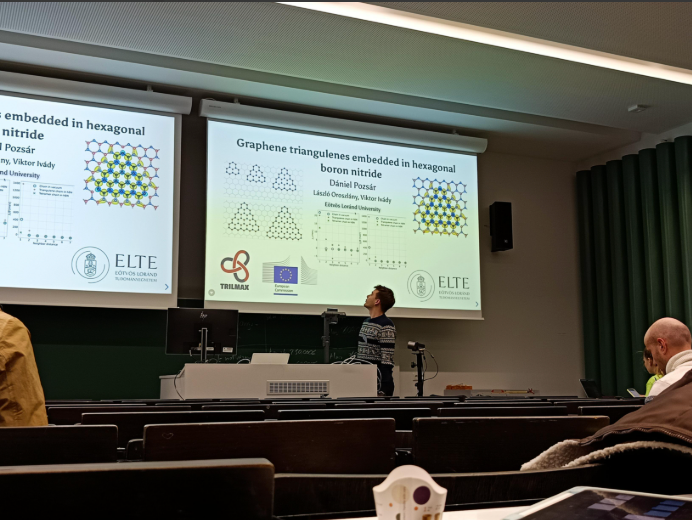
Presenter: Tibor Pozsár, Dániel (Eötvös Loránd University, TRILMAX)
This presentation showcased groundbreaking research on triangulene-shaped substitutional defects in hexagonal boron nitride filled with carbon atoms. The work demonstrated how these triangulene-shaped defects encompass magnetic moments and employed sophisticated ab initio methods to construct Heisenberg-like classical spin models representing their complex interactions. The research revealed crucial insights into how different lattice terminations and system sizes significantly impact the magnetic properties of these novel hybrid systems. This work represents a significant advancement in understanding magnetic behavior in two-dimensional heterostructures and opens new possibilities for engineering magnetic properties in van der Waals materials.
Proximity-Induced Magnetic Phases in CrI₃ Monolayers Coupled to WSe₂
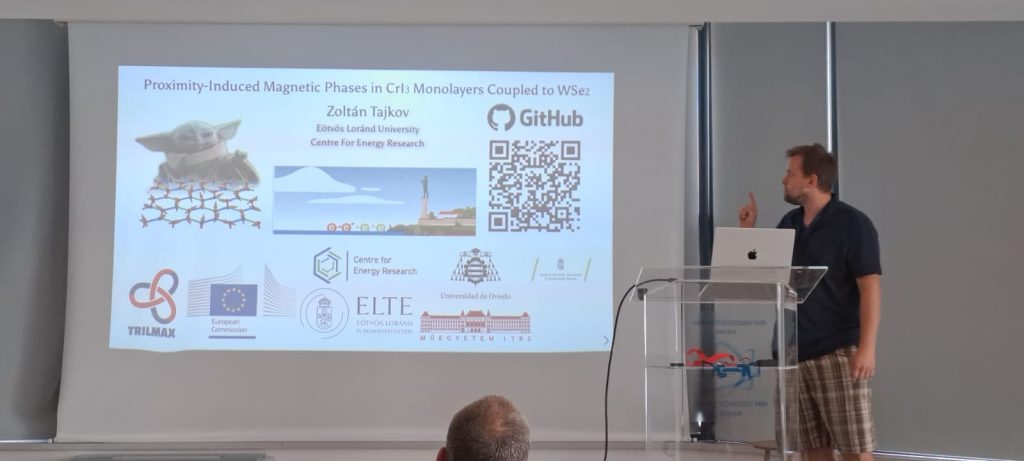
Presenter: Zoltán Tajkov (Eötvös Loránd University)
This presentation explored the fascinating emergence of altered magnetic phases in CrI₃ monolayers induced by proximity effects with WSe₂. Using sophisticated density functional theory (DFT) calculations within the SIESTA framework, the research analyzed magnetic properties through a novel approach for extracting magnetic exchange interaction and onsite anisotropy tensors in extended Heisenberg spin models. The work explicitly incorporated relativistic effects and employed the Liechtenstein-Katsnelson-Antropov-Gubanov torque formalism to evaluate energy variations upon infinitesimal spin rotations. The results provided crucial insights into how two-dimensional magnets are influenced when coupled to materials with strong spin-orbit coupling, while also exploring the impact of varying twist angles and considering the incommensurability of CrI₃ and WSe₂ unit cells.
Tuning Magnetic Exchange Interactions in Two-Dimensional Magnets

Presenter: Prof. László Szunyogh (Budapest University of Technology and Economics)
Professor Szunyogh presented a comprehensive computational study aimed at mimicking various experimental approaches for tuning magnetic interactions in two-dimensional van der Waals magnets. The research focused on evaluating tensorial exchange interactions among all relevant atomic pairs in CrGeSe₃, CrGeTe₃, and Janus Cr₂Ge₂(Se,Te)₃ monolayers, analyzing their dependence on external parameters such as biaxial and uniaxial strain, as well as gate voltage. The study revealed that biaxial and uniaxial strains can significantly modify isotropic exchange couplings, potentially inducing transitions from ferromagnetic to antiferromagnetic phases. Notably, the application of gate voltage was shown to induce Dzyaloshinskii-Moriya interactions, creating vortex patterns whose chirality depends on the electric field direction. The research also highlighted the substantial electric dipole moment of Janus materials, suggesting promising possibilities for multiferroic behavior and advanced spintronic applications.
Conference Impact and Networking
The Budapest delegation’s participation generated considerable interest and sparked numerous engaging discussions with fellow conference attendees. The presentations attracted attention from researchers working on complementary topics, leading to fruitful exchanges about experimental validation possibilities, theoretical frameworks, and potential collaborative opportunities. The interactive nature of the conference sessions facilitated deep scientific discussions that extended beyond the formal presentation periods.
Our researchers engaged with international colleagues from various European institutions, strengthening existing partnerships and establishing new connections that will benefit future collaborative endeavors. The networking opportunities proved particularly valuable for identifying potential joint research proposals and exploring complementary expertise that could enhance ongoing projects within our consortium framework.
Scientific and Strategic Outcomes
The conference participation successfully showcased the high-quality research being conducted within our Budapest node, enhancing the visibility of our work within the international magnetism and spintronics community. The presentations demonstrated our consortium’s capabilities in both theoretical modeling and computational approaches to understanding complex magnetic phenomena in low-dimensional systems.
The exposure gained through these presentations aligns perfectly with European Union priorities for research dissemination and international collaboration. The scientific exchanges facilitated during the conference have already begun yielding new research directions and collaborative opportunities that will strengthen our position in upcoming funding opportunities and joint research initiatives.
Future Implications
The successful participation in “Let’s Give It a Spin!” has established our Budapest node as a recognized contributor to the international magnetism research community. The connections made during the conference are expected to lead to future collaborative publications, joint research proposals, and continued scientific exchange programs.
This conference participation exemplifies our consortium’s commitment to maintaining active engagement with the broader European and international research community, ensuring that our research remains at the forefront of scientific advancement while contributing to the strategic objectives of European research excellence and innovation leadership in advanced materials science.