
On 3 July 2026, Dr Zoltán Tajkov delivered a plenary oral presentation at Graphene2026 – the 16th edition of the Graphene Conference Series, held at the Barceló Sants Hotel in Barcelona, Spain. The conference took place between 30 June and 3 July 2026 and is presented by its organisers as the largest European event in the field of graphene and two-dimensional materials, and as a major meeting point for the international 2D materials community.
Dr Tajkov’s plenary lecture, entitled “Fingerprinting arbitrary stackings of graphite, from perfect rhombohedral to mixed stackings by Electronic Raman Scattering”, presented a theory-supported route for identifying the stacking order of multilayer graphitic systems using electronic Raman scattering. The work addresses a central challenge in layered van der Waals materials: how to connect atomically precise stacking configurations with measurable optical and spectroscopic fingerprints. The Graphene2026 programme listed Dr Tajkov among the plenary speakers, placing the contribution in one of the highest-visibility formats of the conference.
The scientific message of the lecture was that electronic structure calculations and Raman spectroscopy can be combined to distinguish perfect rhombohedral graphite from more complex stacking arrangements. In the underlying work, rhombohedral graphite is described as a platform where strong electronic correlations and topological flat-band physics emerge, while increasing layer number makes stacking-fault identification increasingly difficult. The approach uses the strong layer dependence of the electronic band structure to produce characteristic electronic Raman scattering features, enabling fast, room-temperature optical identification of relevant multilayer configurations.
Although the presented case study focused on graphitic multilayers rather than directly on magnetic van der Waals heterostructures, the activity is strongly aligned with the broader TRILMAX mission. TRILMAX aims to strengthen ELTE’s research capacity in magnetic van der Waals materials, combining theoretical modelling and experimental science, with the long-term goal of enabling energy-efficient and scalable device concepts such as MRAM. Dr Tajkov’s plenary contribution demonstrated precisely this kind of cross-cutting competence: theory-guided interpretation of experimental signatures in layered 2D materials, first-principles-informed modelling of stacking-dependent electronic structure, and close interaction between computational and experimental approaches.
This dissemination activity therefore contributed to TRILMAX beyond the immediate material system. It showcased the consortium’s methodological strengths in the international 2D materials community: modelling complex van der Waals stacks, supporting experimental characterization, and translating electronic-structure insight into practical identification tools. Such expertise is directly relevant for TRILMAX, where magnetic behaviour, proximity effects, interlayer coupling, registry and structural quality are all decisive for understanding and designing magnetic van der Waals materials.
The plenary invitation and successful presentation at Graphene2026 provided high-level international visibility for the TRILMAX research environment and its associated expertise. It also strengthened scientific networking with leading researchers in graphene, twistronics, Raman spectroscopy, van der Waals heterostructures and device-oriented 2D materials. In this sense, the activity supported TRILMAX’s objectives in research excellence, theory–experiment integration, capacity building and dissemination to the broader scientific community. TRILMAX explicitly identifies international conferences, academic lectures and public dissemination as part of its mission to raise the visibility and influence of the consortium’s research.
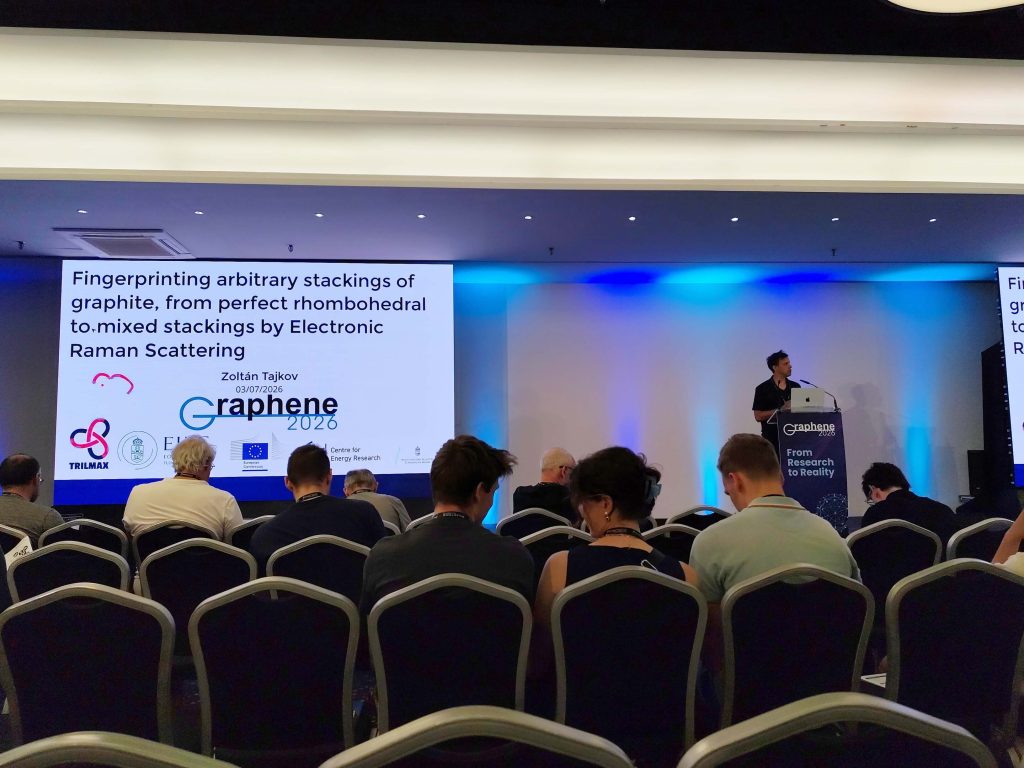
Dr Zoltán Tajkov presenting his plenary lecture at Graphene2026, Barcelona, 3 July 2026. The lecture highlighted theory-supported electronic Raman fingerprinting of multilayer graphitic stackings, demonstrating TRILMAX-relevant expertise in modelling and interpreting the properties of layered van der Waals materials.