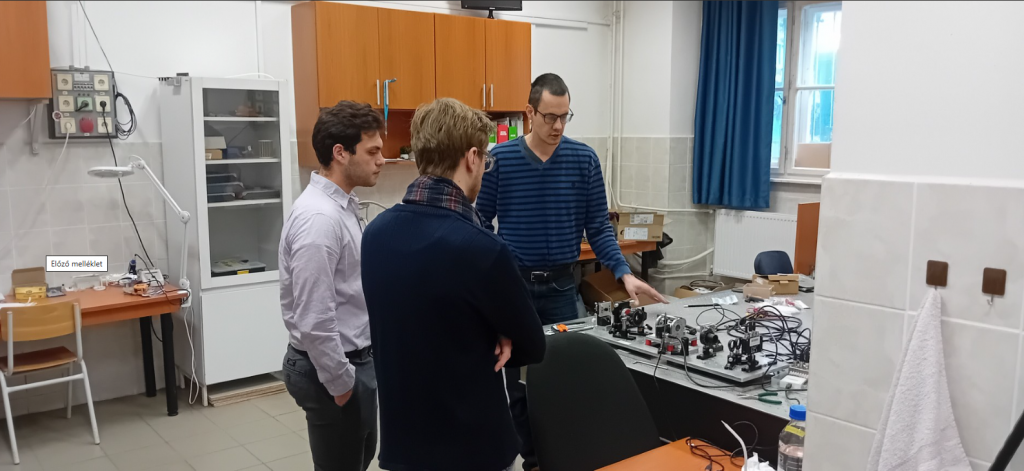
The recent visit from researchers affiliated with Valencia and the Helmholtz-Zentrum Berlin (HZB) Institute to the ELTE node marked a significant milestone in our ongoing consortium collaboration. The visit featured two distinguished speakers who presented cutting-edge research in advanced materials science and spintronics, fostering invaluable scientific exchange and strengthening international partnerships within our EU framework.
Seminar Presentations
Dr. Kai Litzius (HZB Institute): Scanning Transmission X-ray Microscopy Applications
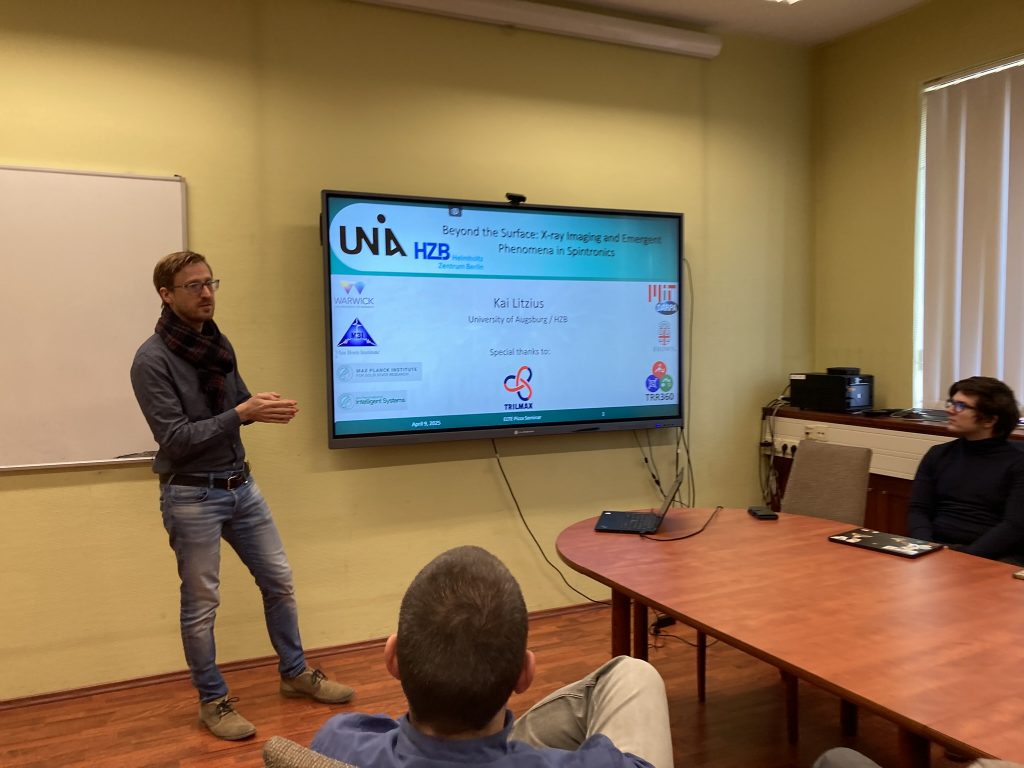
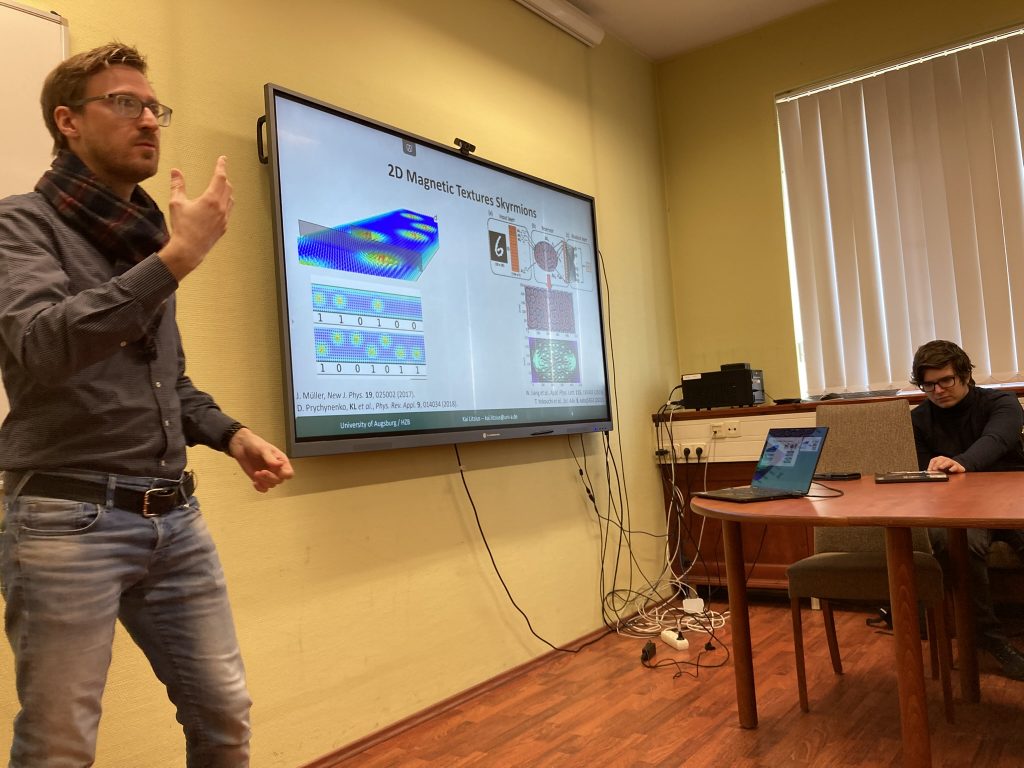
Dr. Litzius delivered a comprehensive seminar on Scanning Transmission X-ray Microscopy (STXM) and its revolutionary applications in spintronics research. His presentation focused on how STXM harnesses X-ray Magnetic Circular Dichroism (XMCD) to enable high-resolution imaging and spectroscopy with exceptional elemental and chemical specificity. The research particularly emphasized current-induced skyrmion dynamics, which hold tremendous promise for next-generation data storage and processing applications due to skyrmions’ topologically protected stability and nanoscale dimensions. Additionally, Dr. Litzius explored STXM’s capabilities in characterizing 2D magnets, demonstrating how this technique enables precise investigation of magnetic ordering and domain structures in atomically thin materials. The work represents a significant advancement in understanding emergent phenomena in spintronics and opens new pathways for developing novel spintronic devices based on these unique magnetic materials.
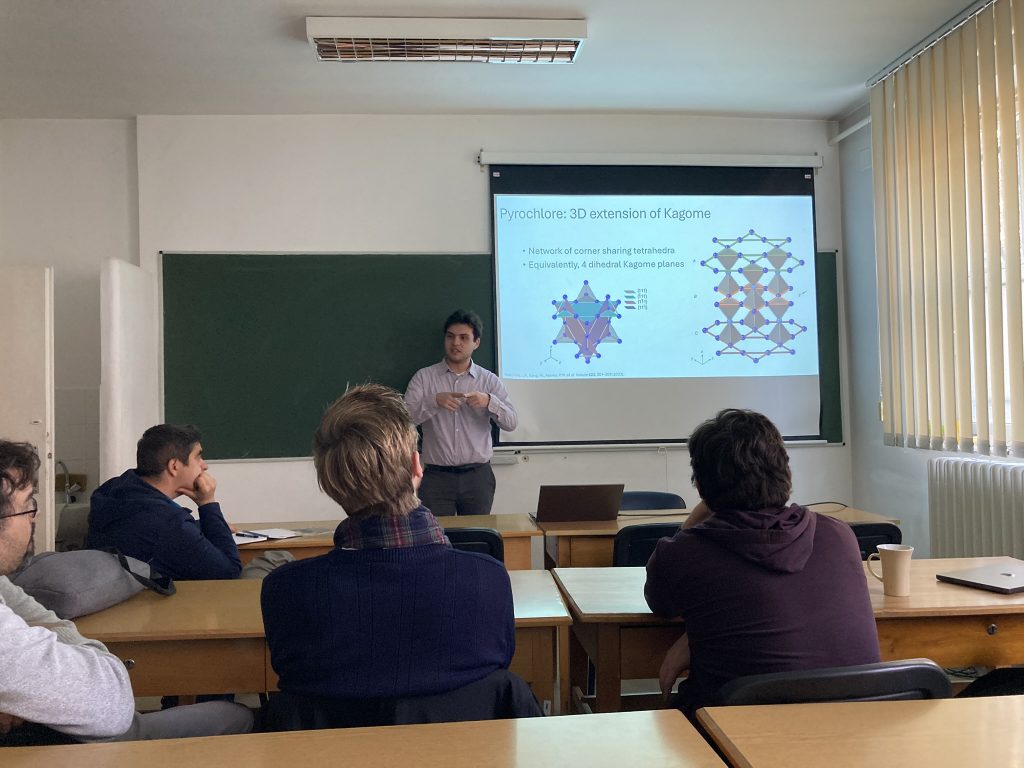
Ryan McTigue: Pyrochlore Lattice Systems
Mr. McTigue presented fascinating insights into pyrochlore systems, describing them as a three-dimensional extension of the well-known kagome lattice structure. His talk explored the unique geometric frustration effects inherent in pyrochlore lattices and their implications for magnetic behavior and quantum phenomena. The presentation highlighted how these complex three-dimensional networks exhibit novel properties that extend beyond their two-dimensional kagome counterparts, offering new opportunities for understanding frustrated magnetism and potentially discovering exotic quantum states.
Scientific Impact and Collaboration
The visit generated exceptionally lively discussions that extended well beyond the formal presentation sessions. Researchers from multiple disciplines engaged in animated exchanges about experimental methodologies, theoretical frameworks, and potential collaborative opportunities. The cross-pollination of ideas between the visiting researchers and our local scientific community proved invaluable, with numerous follow-up discussions planned to explore joint research initiatives.
This collaboration exemplifies the strength and vitality of our research consortium, demonstrating how international partnerships facilitate the advancement of cutting-edge science. The visit has significantly enhanced our research capabilities and opened new avenues for collaborative projects that align perfectly with European Union priorities for scientific excellence and innovation.